Ravensburger puzzles with Northern Lights
There are a number of Ravensburger puzzles with the Northern Lights on them – there aren't that many.
About the Northern Lights
The Northern Lights, also known as the aurora borealis, are a natural light phenomenon primarily visible in the high latitudes around the North Pole, such as in Norway, Finland, Iceland, Alaska, and Canada. This spectacle is caused by the interaction of charged particles from the sun with the Earth's magnetic field and atmosphere. When solar particles, primarily electrons and protons, enter the Earth's magnetosphere, they collide with gases in the atmosphere, releasing energy in the form of light. This process is similar to what happens in a neon light bulb. The Northern Lights can appear in many colors, although green and pink are the most common. These colors are determined by the type of gas the particles collide with: oxygen typically produces green and red light, while nitrogen can produce pink and purple hues. The best time to see the Northern Lights is during long, dark nights, especially in winter. Although the Northern Lights can occur at any time of year, the best time to see them is from September to March, when the nights are at their longest. The Northern Lights are not only an enchanting natural phenomenon but also play a role in various cultures and myths of indigenous peoples in the polar regions. In some cultures, auroras are seen as messengers of the gods or as spirits of ancestors. Scientific research on the Northern Lights helps us better understand the sun and its interactions with Earth, which is important for predicting space weather, which can affect satellite communications and power grids on Earth.
A time-lapse of a Northern Lights puzzle
Overview of all Ravensburger puzzles with the Northern Lights
| Image | Number of pieces | Box No. | Name Dutch | Name English | |
|---|---|---|---|---|---|
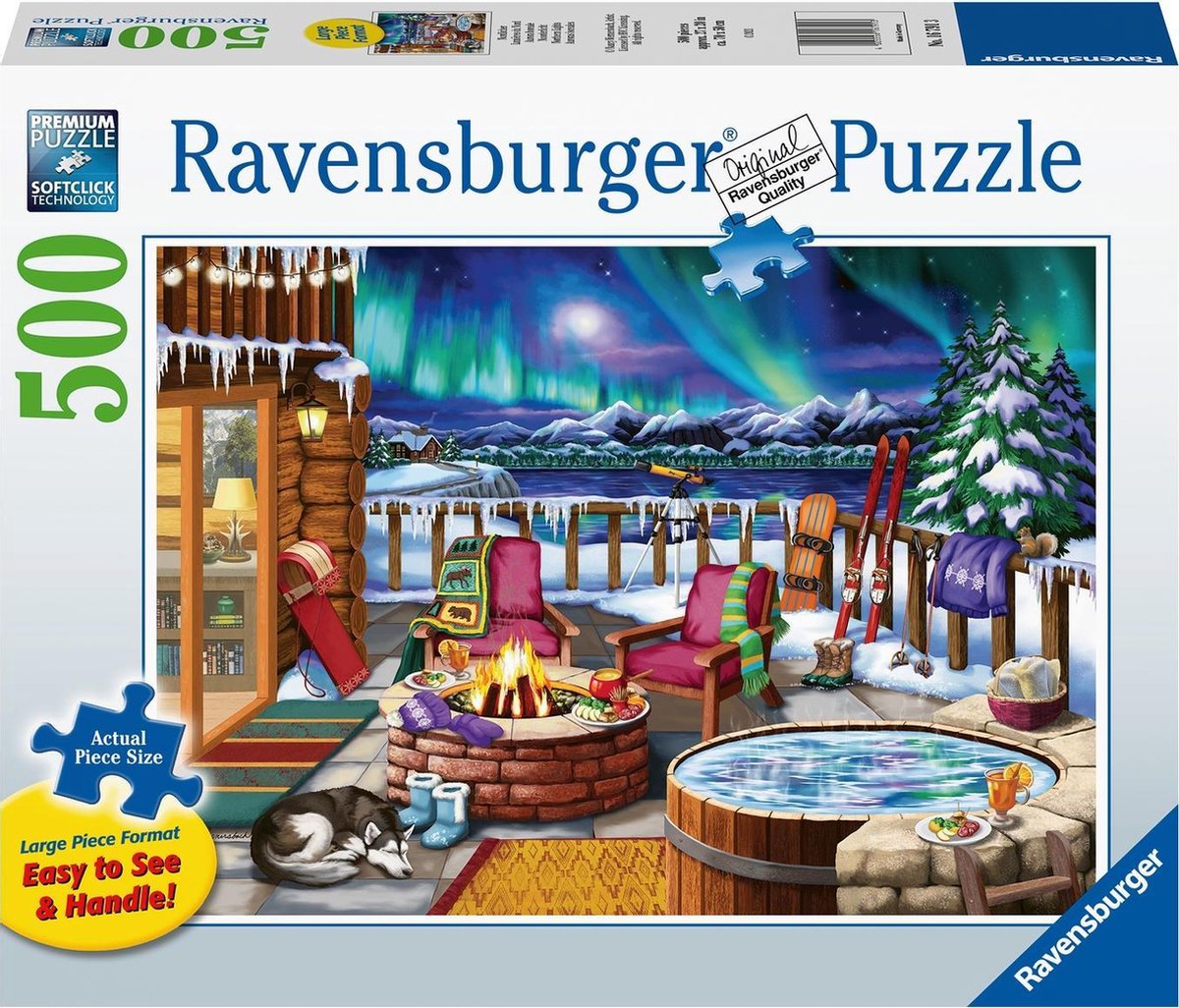 | 500 | 167913 | Northern lights | Northern Lights |
Which puzzles for which ages?
If you have any doubts about a puzzle and the age of a child, you will find an overview in the table below (possibly more explanation on the 'what age how many pieces'):
| Age | Puzzle How many pieces | Order via Bol.com | Order via Amazon.nl | |
|---|---|---|---|---|
| 1 Year - Puzzles | Max 5-10 | Via bol.com | Via Amazon.nl | |
| 2 Year - Puzzles | Max 10-16 | Via bol.com | Via Amazon.nl | |
| 3 Year - Puzzles | Max 16-24 | Via bol.com | Via Amazon.nl | |
| 4 Years - Puzzles (Group 1) | Max 24-50 | Via bol.com | Via Amazon.nl | |
| 5 Years - Puzzles (Group 1+2) | Max 50-100 | Via bol.com | Via Amazon.nl | |
| 6 Years - Puzzles (Group 2+3) | Max 100-250 | Via bol.com | Via Amazon.nl | |
| 7 Years - Puzzles (Group 3+4) | Max 250-500 | Via bol.com | Via Amazon.nl | |
| 8 Years - Puzzles (Group 4+5) | Max 250-500 | Via bol.com | Via Amazon.nl | |
| 9 Years - Puzzles (Group 5+6) | Max 250-500 | Via bol.com | Via Amazon.nl | |
| 10 Years - Puzzles (Group 6+7) | Max 500-1000 | Via bol.com | Via Amazon.nl | |
| 11 Years - Puzzles (Group 7+8) | Max 500-1000 | Via bol.com | Via Amazon.nl | |
| 12 Years - Puzzles (Group 8) | Max 500-1000 | Via bol.com | Via Amazon.nl | |
| 12 years and older | More than 1000 | Via bol.com | Via Amazon.nl |